

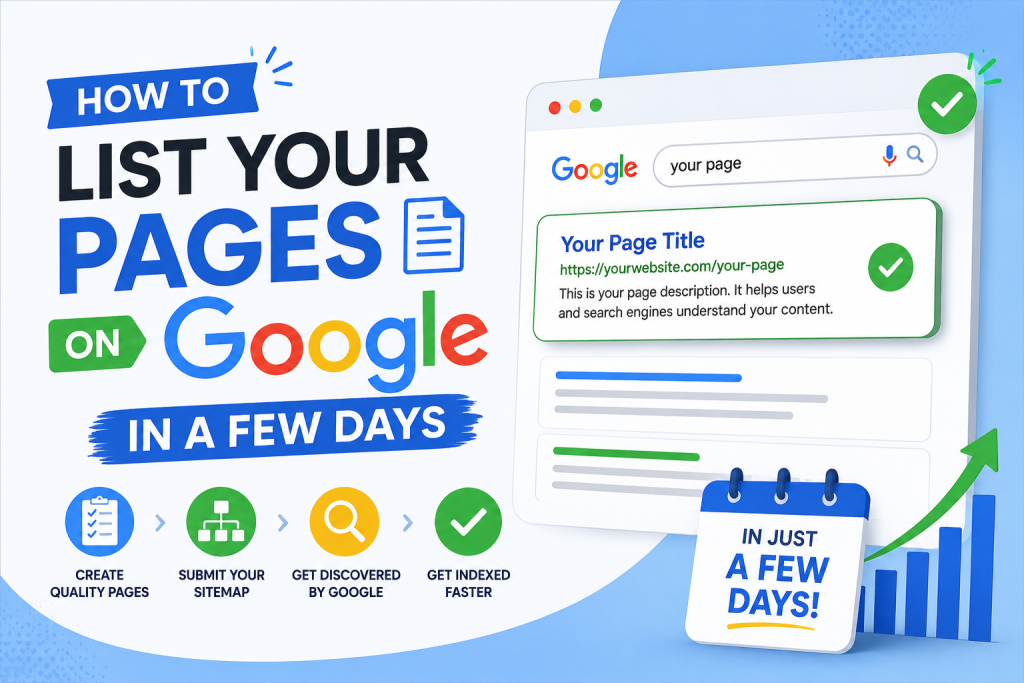
One of the most frustrating things after creating a website is to search your business name on Google… and find nothing.
The common assumption is that Google will automatically find every page you publish. But it doesn’t work that way.
Google needs to discover your pages, understand them and decide if they’re worthy of showing in search results. In case that your website is not configured properly it can take weeks or sometimes even months to get indexed.
The good news is – there are a few simple things you can do to dramatically speed things up.
Here’s what really works.
1. Sign up your website in Google Search Console
If you haven’t already linked your website to Google Search Console, do that first.
It’s like formally introducing your website to Google.
Once your site is verified, you can submit your sitemap and also manually request the indexing of important pages.
This alone can make a huge difference.
2. Generate and Upload a Sitemap
A sitemap is basically a file that informs Google:
“Hey, all the pages out there on my website here.
Your sitemap looks something like this:
yourwebsite.com/sitemap.xm
Create it, and then submit it inside Google Search Console.
This way Google can find pages way faster instead of finding them randomly over time.
3. Ask for Indexing After Publishing
Don’t just sit there and wait for Google to discover your new page or blog when you publish it.
Go to Google Search Console, enter the URL of the page you want to be indexed in the URL Inspection Tool and click on ‘Request Indexing’.
Sometimes this results in pages getting indexed in hours.
This step is more important for newer websites.
4. Ensure Your Website Loads Quickly
Google does not like slow sites.
Slow-loading pages – Google may crawl fewer pages from your site if your pages load slowly.
Simple improvements such as:
- Image compression
- Better hosting
- Reducing useless plugins
- Enable caching
can be very helpful.
A fast website helps SEO, but also provides a better user experience
5. Linking Your Pages Correctly
A common mistake people make is publishing pages that are completely isolated.
Google finds pages primarily via links.
So when you create a new page, be sure to link to it from:
- Your main page
- Other blog sites
- Pages of categories
- Product web pages
Google uses internal links to naturally navigate your site.
6. Do Not Publish Thin Content
This matters.
Google is not quick to index pages with very little value.
Copying. Short content. Content that is written only for SEO. May cause slower indexing.
But write content that is useful to people instead.
- answer real questions
- Be explicit.
- Is it possible to be a human being and a communist?
That works out better in the long run always.
7. Make Your Pages Public
Google also sees activity around your pages.
When you share your blog or product page on social media platforms like:
- Insta
- X/Twitter
… it creates signals to make discovery happen faster.
Even a few backlinks or shares can help Google notice your page sooner.
8. See if the mobile version is working okay
Google now looks at the mobile version of your site first.
Broken looking sites on phones can hurt your indexing and your rankings.
Make sure to always test your pages on mobile before going live.
9. Avoid Common Technical Errors
Sometimes pages simply don’t get indexed for technical reasons.
Such as:
- noindex meta tags
- Links that are broken
- Incorrect redirects
- robots.txt files that are blocked
can block Google from accessing your pages.
Even experienced website owners occasionally miss these.
10. Keep your website up and running
Active sites get crawled more often by Google.
Google will start crawling your site more often when you consistently publish new content, update old pages, and continue to improve your website.
That means future pages get indexed faster as well.
Final Thoughts
Getting listed on Google isn’t magic.
Most of the time websites are invisible because they lack basic SEO setup.
If you concentrate on:
- Requests for proper indexing,
- Content is good
- Loads quickly
- Linking from within
- Updates frequently
… your pages can start to show up on Google surprisingly fast.
Consistency is the key.
When Google trusts your website it will be much easier to index every new page you publish.
Join the movement
Get weekly insights on sustainable tech delivered to your inbox.